APSIPA ASC 2026
ATW-GS
Anisotropic transmittance windows for anti-aliased 3D Gaussian splatting
- Anti-aliasing
- Multi-scale rendering
- 3D Gaussian splatting
2026
Structure-aware, view-consistent densification for accelerated 3D Gaussian splatting
Hana L. Goshu, Tadesse G. Wakjira, Mostafa Fouda, Kin-Man Lam
Ground truthDrag to compareFastGS-Adaptive
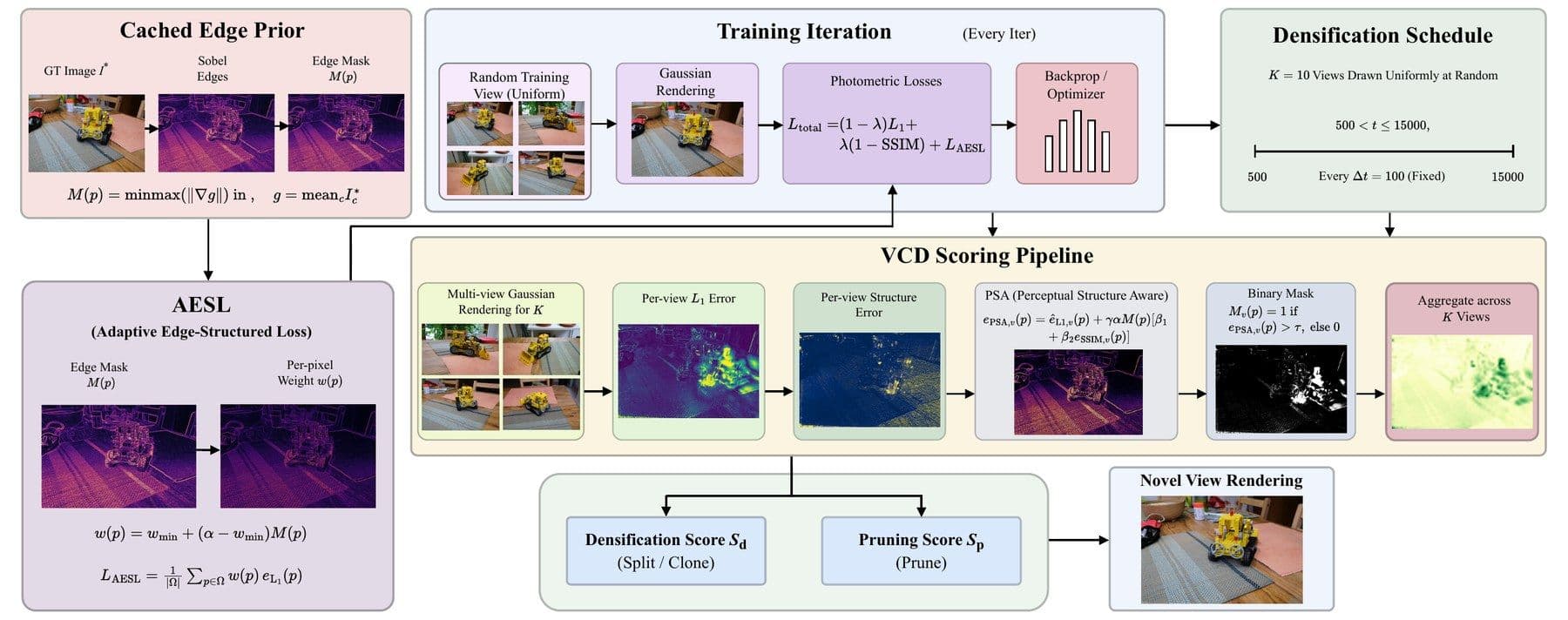
Three-dimensional Gaussian splatting is the dominant representation for real-time novel view synthesis, and recent frameworks have reduced per-scene training from tens of minutes to a few. In the fastest of these, primitives are selected for subdivision by counting photometric residuals above a fixed threshold within their footprints. Neither this criterion nor the objective that produces the residuals accounts for image structure. A residual on a thin geometric edge is therefore treated like one on a flat surface, so primitives are added where they yield little benefit while fine structure remains under-represented. To address this limitation, a structure-aware densification framework with two complementary components is proposed. One of them, an adaptive edge-structured loss, modulates the per-pixel photometric penalty using a gradient prior derived from the ground-truth image. As the prior is constant per camera, it is computed once and cached at negligible cost. The other, a perceptual structure-aware densification score, replaces the thresholded residual in the scoring rule with an importance map that combines the photometric residual with an edge-gated local structural-similarity error. Subdivision is thereby directed toward primitives carrying structural error instead of those covering smooth surfaces. Neither modifies the rasterizer or the rendering pipeline. The proposed model achieves 28.12 dB peak signal-to-noise ratio, 0.825 structural similarity, and 0.205 learned perceptual image patch similarity on the Mip-NeRF 360 dataset, compared with 27.93 dB, 0.820, and 0.216 for the baseline. A component ablation confirms that each mechanism contributes, and that the two combined attain the best value of every metric.
FastGS-Adaptive keeps the FastGS training schedule and changes what it rewards. Both components use image structure, and neither modifies the rasterizer or the rendering pipeline.
| Method | Mip-NeRF 360 PSNR ↑ | SSIM ↑ | LPIPS ↓ | Deep Blending PSNR ↑ | SSIM ↑ | LPIPS ↓ | Tanks and Temples PSNR ↑ | SSIM ↑ | LPIPS ↓ |
|---|---|---|---|---|---|---|---|---|---|
| 3DGS | 27.53 | .812 | .221 | 29.71 | .903 | .241 | 23.71 | .850 | .170 |
| Mini-Splatting | 27.32 | .821 | .217 | 29.99 | .907 | .244 | 23.46 | .844 | .181 |
| Speedy-Splat | 26.91 | .781 | .295 | 29.42 | .898 | .272 | 23.38 | .816 | .242 |
| Taming-3DGS | 27.48 | .794 | .261 | 29.50 | .894 | .278 | 23.89 | .833 | .214 |
| DashGaussian | 27.73 | .817 | .218 | 29.65 | .906 | .246 | 24.00 | .853 | .178 |
| FastGS | 27.56 | .797 | .261 | 30.03 | .901 | .270 | 24.15 | .839 | .210 |
| FastGS-Big | 27.93 | .820 | .216 | 30.12 | .907 | .243 | 24.39 | .855 | .175 |
| FastGS-Adaptive | 28.12 | .825 | .205 | 30.17 | .910 | .239 | 24.43 | .855 | .170 |
APSIPA ASC 2026
Anisotropic transmittance windows for anti-aliased 3D Gaussian splatting
Stabilizing joint optimization with weight averaging and multi-resolution supervision for egocentric 3D Gaussian splatting
Enhanced sparse-view 3D Gaussian splatting via stereo-depth bootstrapping