APSIPA ASC 2026
ATW-GS
Anisotropic transmittance windows for anti-aliased 3D Gaussian splatting
- Anti-aliasing
- Multi-scale rendering
- 3D Gaussian splatting
2026
Enhanced sparse-view 3D Gaussian splatting via stereo-depth bootstrapping
Hana L. Goshu, Tadesse G. Wakjira, Kin-Man Lam
Ground truthDrag to compareStereoSplat
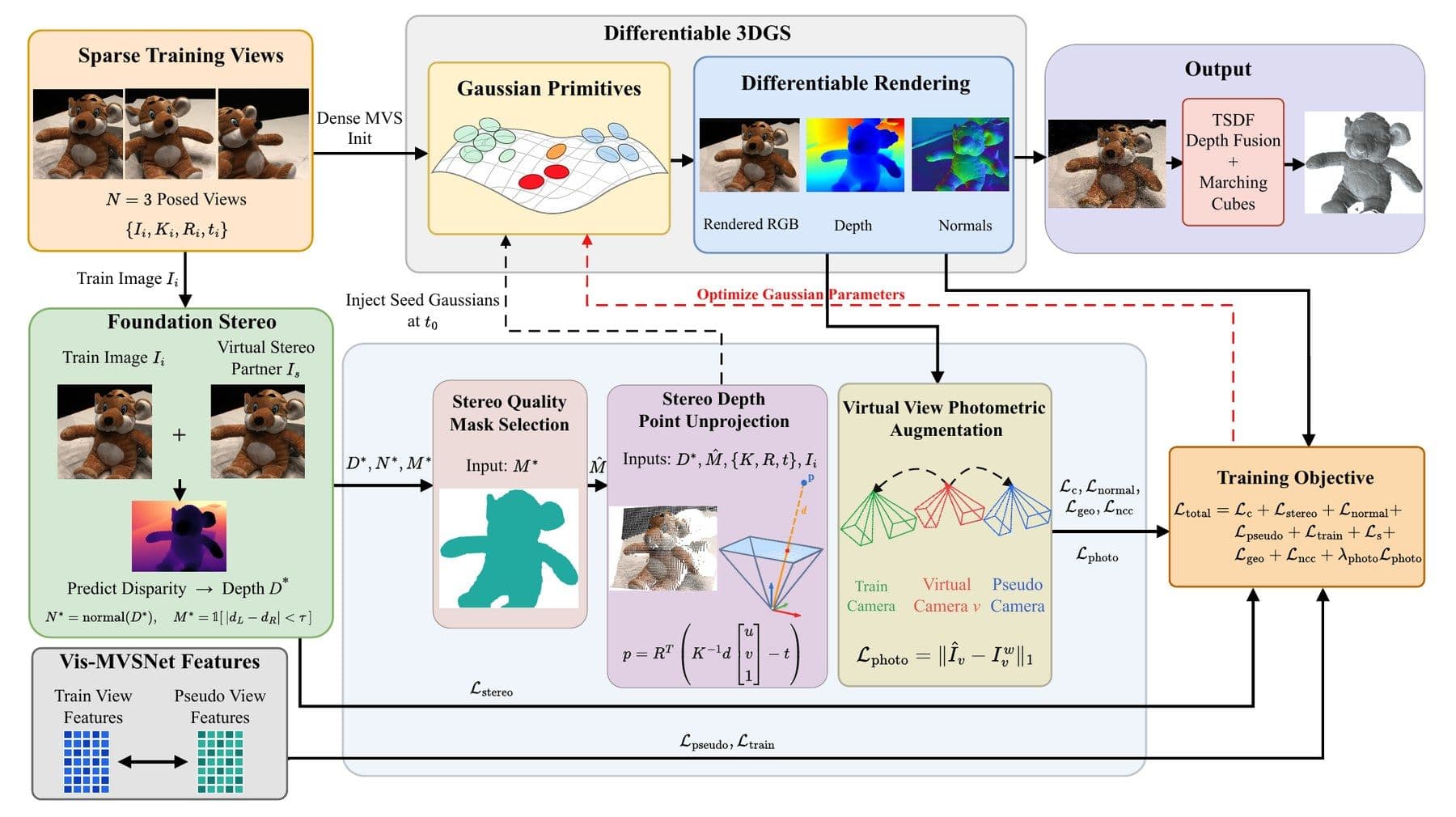
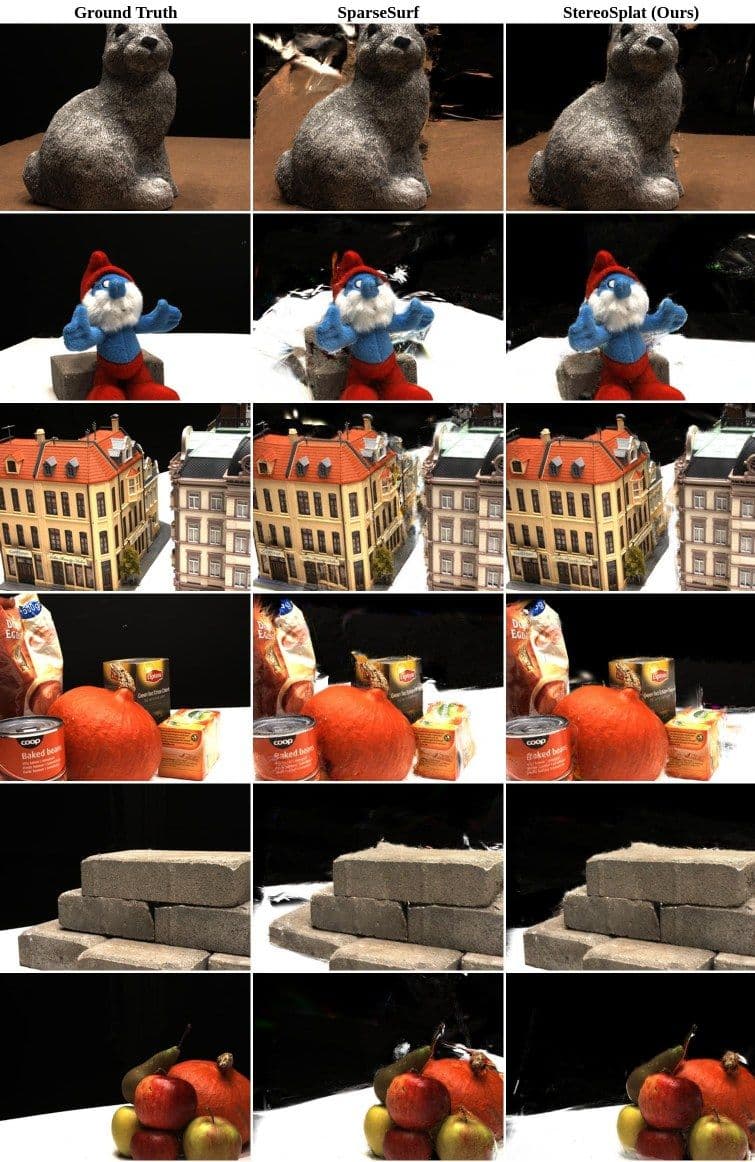
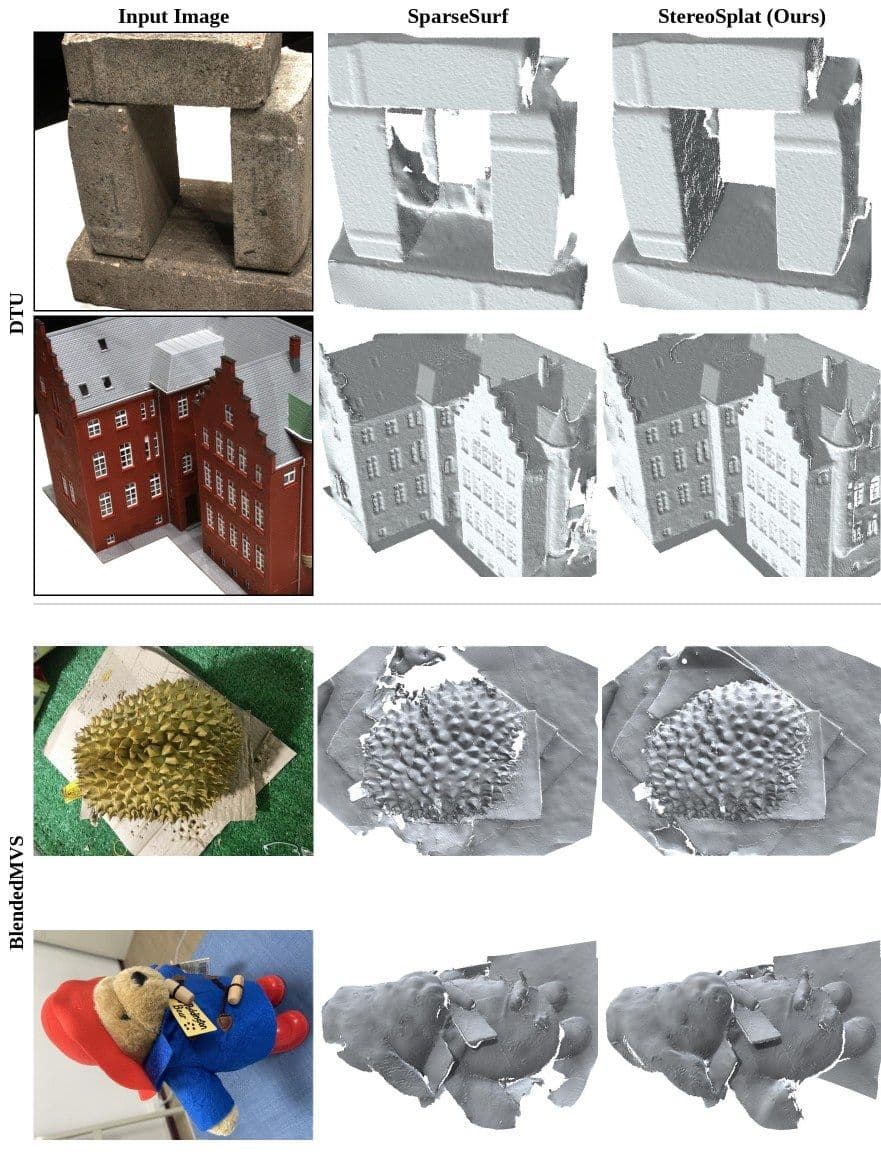
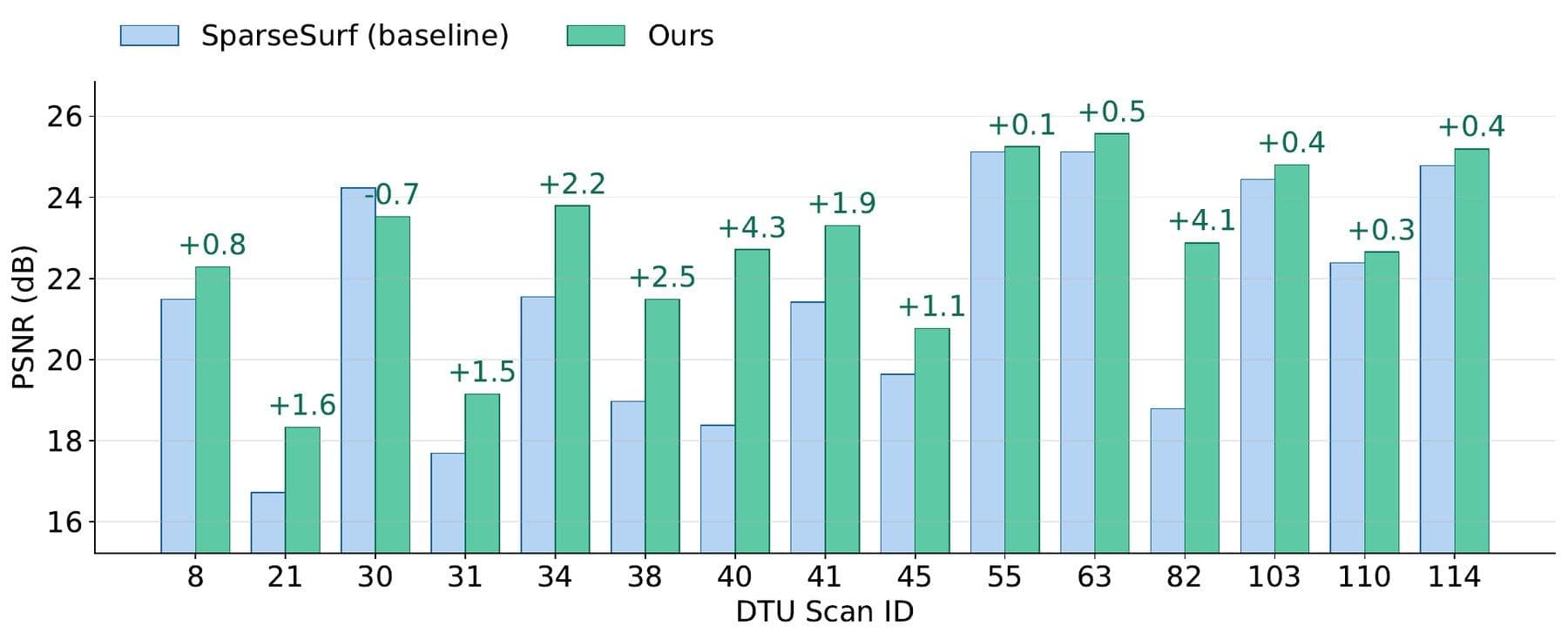
Reconstructing three-dimensional (3D) scenes from a few input views remains difficult when dense image acquisition is impractical. Recent sparse-view surface reconstruction methods based on 3D Gaussian Splatting rely on stereo matching to guide optimization; however, the dense metric depth they compute is underexploited, serving merely as a loss signal that adjusts existing primitives. Therefore, this study proposes StereoSplat, which converts this overlooked depth into explicit scene geometry and thereby improves novel-view synthesis while preserving or enhancing surface reconstruction. Specifically, Stereo-depth Point Unprojection lifts dense stereo-depth maps into 3D seed points and injects them as new Gaussian primitives, filling coverage gaps left by the initial dense multi-view stereo point cloud in textureless and occluded regions. To ensure reliability, Stereo Quality Mask Selection retains only points that pass a left-right consistency check. Our analysis further shows that this within-view criterion is preferable to cross-view filtering, as the latter discards genuine surfaces visible from only a single view. In addition, Virtual View Photometric Augmentation enriches supervision by synthesizing virtual viewpoints near the training cameras and comparing the rendered appearance with forward-warped images. On the DTU dataset, StereoSplat attains a PSNR of 22.78 dB on the novel-view synthesis benchmark, surpassing state-of-the-art methods with consistent gains in SSIM, LPIPS, and AVGE. Moreover, surface accuracy is preserved under the large-overlap setting and improved under the little-overlap setting. Overall, these results reveal that initialization coverage, instead of optimization regularization, is the dominant bottleneck in Gaussian-based sparse-view reconstruction.
StereoSplat turns the dense stereo depth estimated during training into new geometry, instead of using it only as a loss signal.
| Method | PSNR ↑ | SSIM ↑ | LPIPS ↓ | AVGE ↓ |
|---|---|---|---|---|
| Mip-NeRF | 8.68 | 0.571 | 0.353 | 0.315 |
| RegNeRF | 18.89 | 0.745 | 0.190 | 0.107 |
| FreeNeRF | 19.92 | 0.787 | 0.182 | 0.095 |
| SparseNeRF | 19.55 | 0.769 | 0.201 | 0.102 |
| DS-NeRF | 16.29 | 0.559 | 0.451 | 0.192 |
| 3DGS | 17.65 | 0.816 | 0.146 | 0.102 |
| DNGaussian | 18.91 | 0.790 | 0.176 | 0.101 |
| FSGS | 17.14 | 0.818 | 0.162 | 0.110 |
| CoR-GS | 19.21 | 0.853 | 0.119 | 0.082 |
| Binocular3DGS | 20.71 | 0.862 | 0.111 | — |
| NexusGS | 20.21 | 0.869 | 0.102 | 0.071 |
| FatesGS | 17.95 | 0.833 | 0.129 | 0.100 |
| SparseSurf | 21.31 | 0.886 | 0.089 | 0.067 |
| StereoSplat | 22.78 | 0.896 | 0.081 | 0.056 |
| Method | Little overlap | Large overlap |
|---|---|---|
| COLMAP | 2.61 | 1.52 |
| SparseNeuS (fine-tuned) | 3.34 | 1.27 |
| VolRecon | 3.02 | 1.38 |
| UFORecon | 1.40 | 0.99 |
| NeuS | 4.28 | 4.00 |
| VolSDF | 4.26 | 3.41 |
| MonoSDF | 1.86 | 2.93 |
| NeuSurf | 1.35 | 0.99 |
| 2DGS | 2.52 | 1.69 |
| PGSR | 3.97 | 1.82 |
| FatesGS | 1.37 | 0.92 |
| SparseSurf | 1.05 | 0.89 |
| StereoSplat | 0.97 | 0.86 |
APSIPA ASC 2026
Anisotropic transmittance windows for anti-aliased 3D Gaussian splatting
Stabilizing joint optimization with weight averaging and multi-resolution supervision for egocentric 3D Gaussian splatting
Structure-aware, view-consistent densification for accelerated 3D Gaussian splatting