APSIPA ASC 2026
ATW-GS
Anisotropic transmittance windows for anti-aliased 3D Gaussian splatting
- Anti-aliasing
- Multi-scale rendering
- 3D Gaussian splatting
2026
Stabilizing joint optimization with weight averaging and multi-resolution supervision for egocentric 3D Gaussian splatting
Hana L. Goshu, Tadesse G. Wakjira, Mostafa Fouda, Kin-Man Lam
Ground truthDrag to compareSMAGaussian
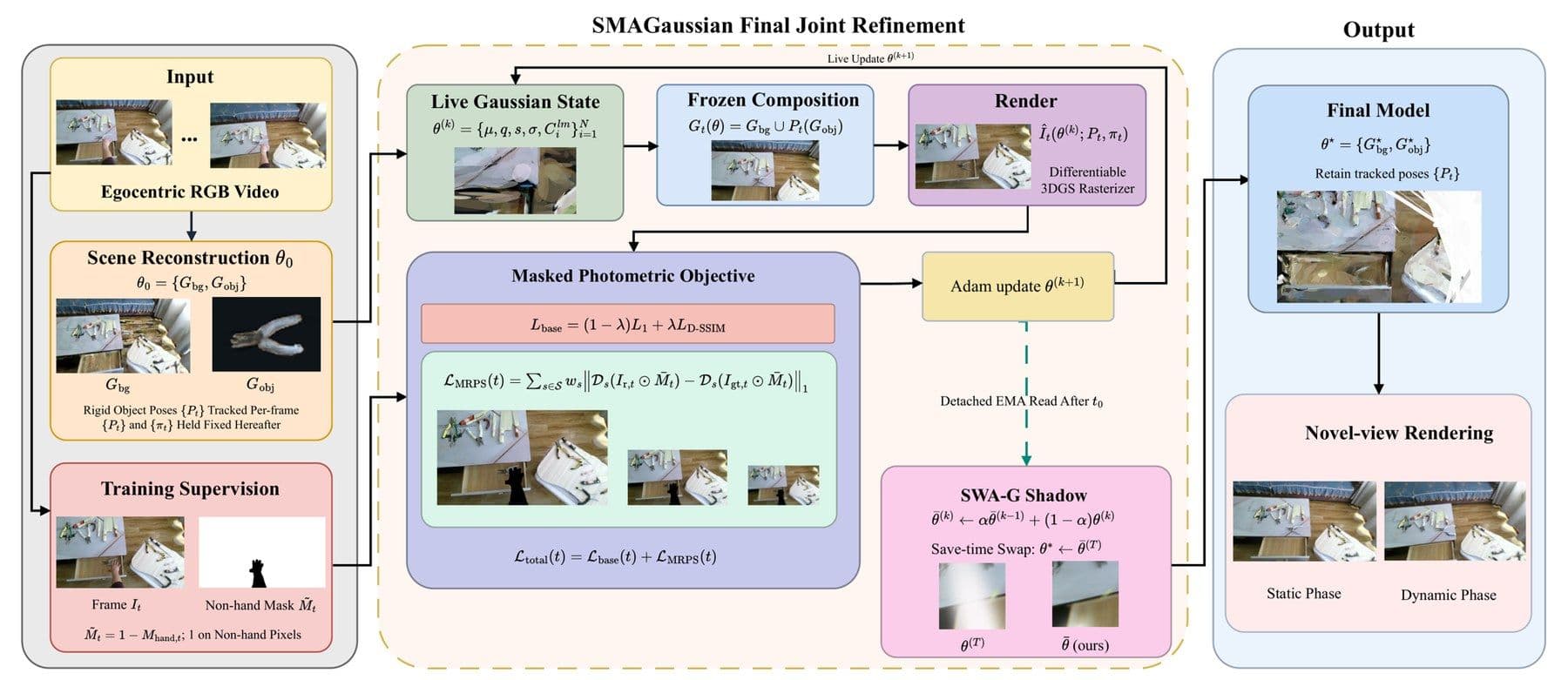
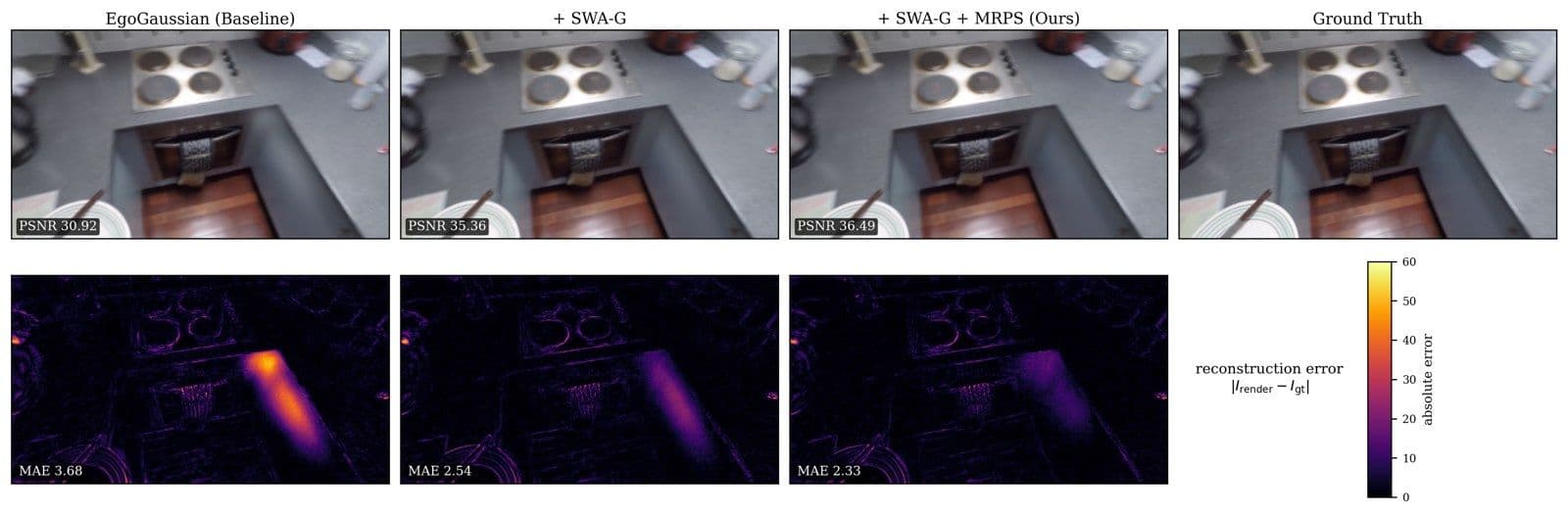
3D Gaussian Splatting (3DGS) has emerged as a powerful explicit scene representation for real-time novel-view synthesis, and recent work has extended it to egocentric dynamic scene reconstruction. Existing methods jointly refine all Gaussian parameters in a final optimization stage, after estimating the static scene, object shape, and per-frame object poses from egocentric video. However, we observe that this stage often suffers from optimization instability: the optimizer oscillates within a flat basin of near-optimal solutions rather than converging to its centre, which degrades reconstruction fidelity on unseen views. Therefore, we propose SMAGaussian, a simple yet effective framework to improve the stability and quality of this joint refinement stage. SMAGaussian introduces two complementary modules with zero additional learnable parameters, namely, Stochastic Weight Averaged Gaussians (SWA-G) and Multi-Resolution Photometric Supervision (MRPS). SWA-G maintains a detached exponential moving average of all Gaussian parameters throughout optimization and replaces the final parameters with their temporal average at convergence. This approach exploits the explicit and fixed-structure nature of 3DGS, where parameter-space averaging remains particularly meaningful, whereas the effectiveness of weight averaging in implicit neural representations is less predictable due to parameter entanglement. In parallel, MRPS augments the conventional full-resolution photometric loss with an auxiliary L1 loss evaluated at two downsampled scales, providing complementary low-frequency gradient signals to the standard full-resolution photometric loss. SWA-G and MRPS operate along complementary axes: SWA-G stabilizes the optimization trajectory in parameter space, while MRPS reshapes the loss landscape through multi-scale supervision. Extensive experiments on the HOI4D and EPIC-KITCHENS benchmarks demonstrate that SMAGaussian achieves peak signal-to-noise ratio (PSNR) improvements of up to 2.07 dB and 3.56 dB, respectively, along with consistent gains in structural similarity index (SSIM) and learned perceptual image patch similarity (LPIPS). Ablation studies confirm that SWA-G provides the dominant improvement, while MRPS contributes a consistent additive refinement. Notably, all gains are achieved without additional learnable parameters, without increasing the Gaussian count, and without modifying the upstream pipeline, while incurring less than 4% training overhead and zero inference cost.
SMAGaussian operates entirely within the final joint refinement stage, where object poses are frozen and only the Gaussian parameters are optimized. Both modules add no learnable parameters, keep the Gaussian count fixed, and add no inference cost.
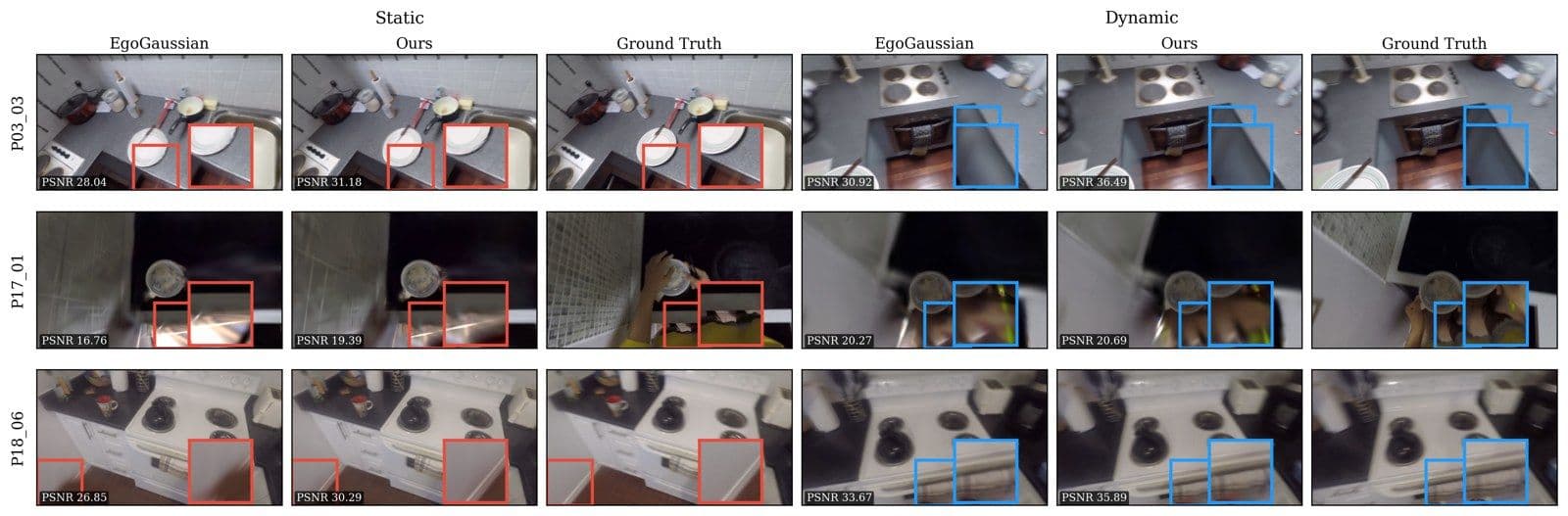
Static and dynamic evaluation frames are reported separately.
| Method | Static SSIM ↑ | Static PSNR ↑ | Static LPIPS ↓ | Dynamic SSIM ↑ | Dynamic PSNR ↑ | Dynamic LPIPS ↓ |
|---|---|---|---|---|---|---|
| 4DGS | 0.88 | 25.33 | 0.13 | 0.89 | 25.34 | 0.13 |
| 4DGS w/o hands | 0.94 | 28.69 | 0.08 | 0.94 | 27.33 | 0.10 |
| Def-3DGS | 0.90 | 25.85 | 0.11 | 0.90 | 25.71 | 0.12 |
| Def-3DGS w/o hands | 0.94 | 28.09 | 0.08 | 0.94 | 26.92 | 0.10 |
| EgoGaussian | 0.96 | 30.99 | 0.08 | 0.95 | 30.33 | 0.09 |
| SMAGaussian | 0.97 | 32.62 | 0.08 | 0.96 | 32.40 | 0.09 |
| Method | Static SSIM ↑ | Static PSNR ↑ | Static LPIPS ↓ | Dynamic SSIM ↑ | Dynamic PSNR ↑ | Dynamic LPIPS ↓ |
|---|---|---|---|---|---|---|
| 4DGS | 0.84 | 26.84 | 0.20 | 0.79 | 22.54 | 0.24 |
| 4DGS w/o hands | 0.87 | 28.90 | 0.16 | 0.80 | 23.13 | 0.23 |
| Def-3DGS | 0.86 | 27.35 | 0.18 | 0.81 | 23.15 | 0.22 |
| Def-3DGS w/o hands | 0.86 | 27.63 | 0.17 | 0.82 | 23.27 | 0.21 |
| EgoGaussian | 0.85 | 28.33 | 0.19 | 0.88 | 28.34 | 0.17 |
| SMAGaussian | 0.88 | 30.23 | 0.16 | 0.90 | 31.90 | 0.14 |
APSIPA ASC 2026
Anisotropic transmittance windows for anti-aliased 3D Gaussian splatting
Structure-aware, view-consistent densification for accelerated 3D Gaussian splatting
Enhanced sparse-view 3D Gaussian splatting via stereo-depth bootstrapping